
LLMO Explained: SEO in the Age of AI Search
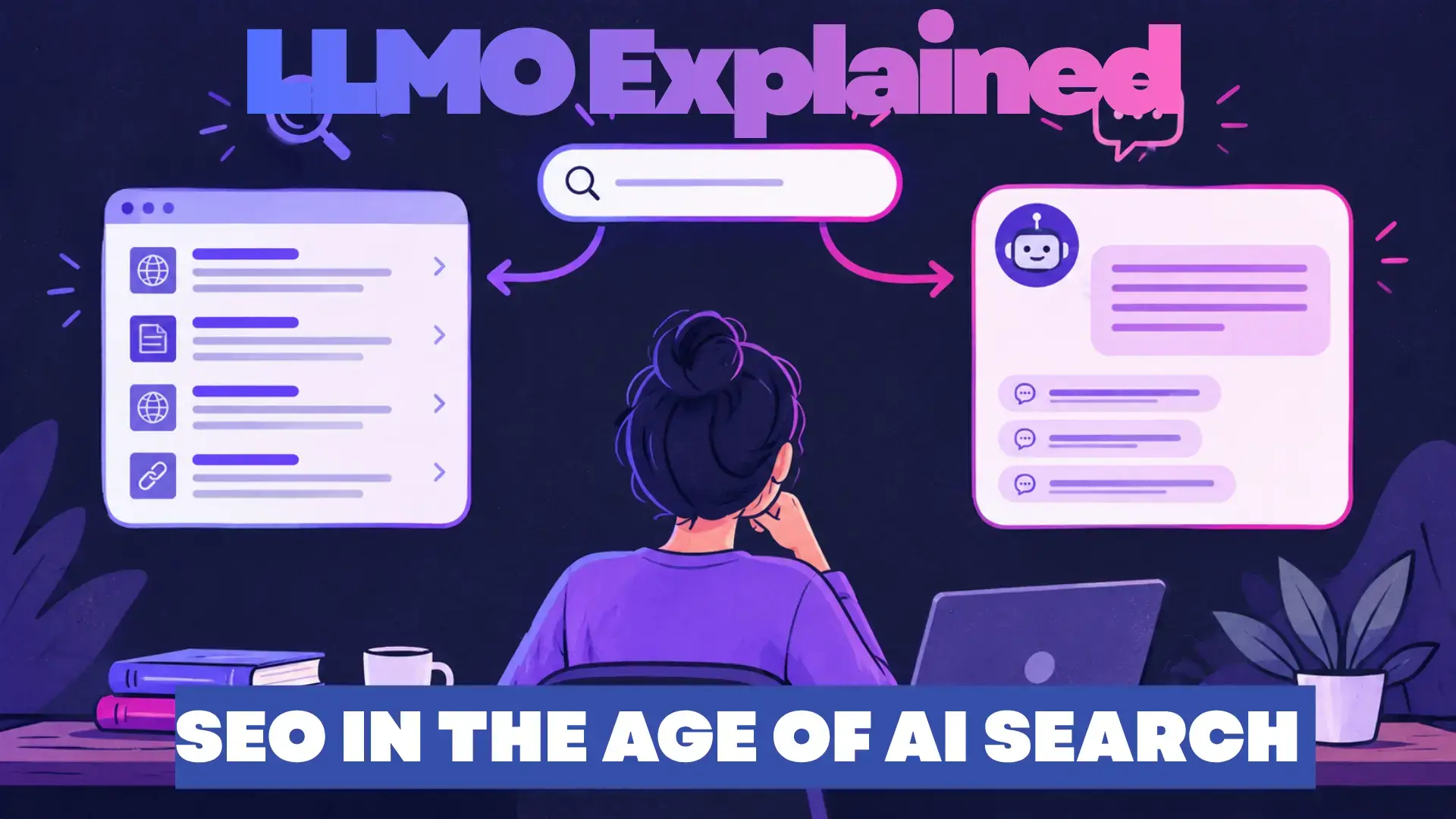
A few years ago, ranking on page one of Google was the finish line. You picked your keywords, built your backlinks, optimized your meta tags, and waited for the traffic to roll in. That formula isn't dead, but it's no longer the whole game.
Today, a growing share of people never click through to a website at all. They ask ChatGPT, Google's AI Overviews, Perplexity, or Claude a question, and they get an answer right there — often with a source or two quoted, and nine other sources ignored completely. If your content isn't one of the ones the AI decided to trust, you don't just rank lower. You disappear from the conversation entirely.
This isn't a guess about where things are heading — it's already the majority behavior. A June 2026 study by SparkToro, using Similarweb clickstream data, found that 68% of US Google searches now end without a single click to any website, up from about 60% just two years earlier. AI Overviews alone now appear on more than one in five searches, and when they do, clicks to the underlying sources drop by roughly 60%. In plain terms: for most searches today, the answer is the destination — your website was never going to be visited either way, unless the AI decided you were worth quoting.
This is the problem LLMO exists to solve.
The shift in one line: Traditional SEO gets you a spot on the results page. LLMO gets your words repeated inside the answer itself — even when the reader never visits your site.
What LLMO Actually Means
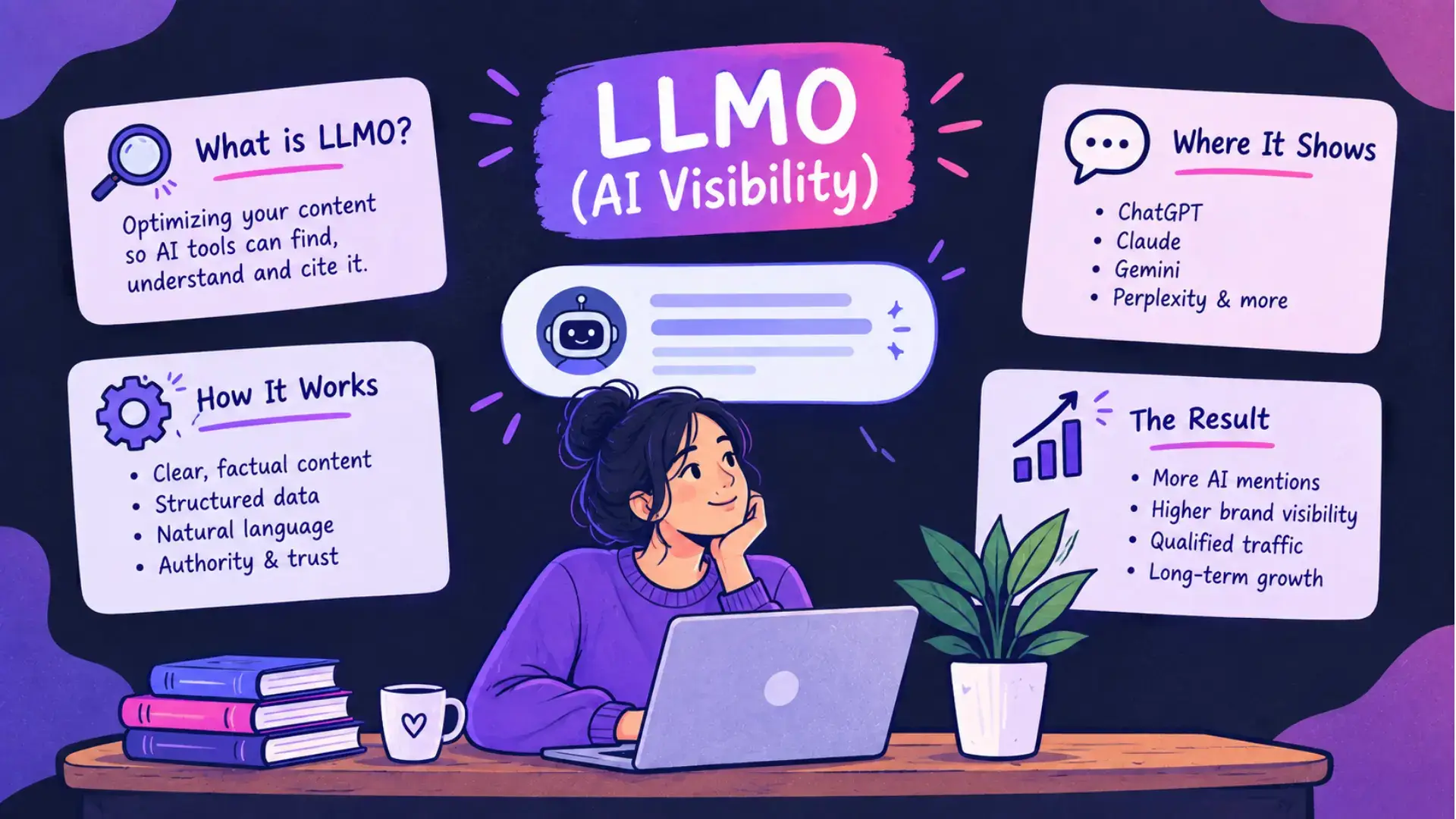
LLMO stands for Large Language Model Optimization — sometimes called AI Search Optimization or Generative Engine Optimization (GEO). At its core, it's the practice of structuring your content, your data, and your online presence so that AI models can understand it, trust it, and choose to reference it when someone asks a related question.
Where traditional SEO asks, "How do I rank on a results page?" — LLMO asks a different question: "How do I become the answer?"
These aren't competing disciplines. LLMO builds on top of solid SEO. If your site has weak technical foundations, thin content, or no credibility signals, no amount of "AI optimization" will save it. But if your SEO fundamentals are strong, LLMO is what determines whether a language model actually pulls your content into its response — or quietly skips past it in favor of a competitor's. Google itself confirms that AI Overviews and AI Mode run on the same underlying Search index as classic results, which means strong SEO fundamentals remain the entry ticket to AI visibility.
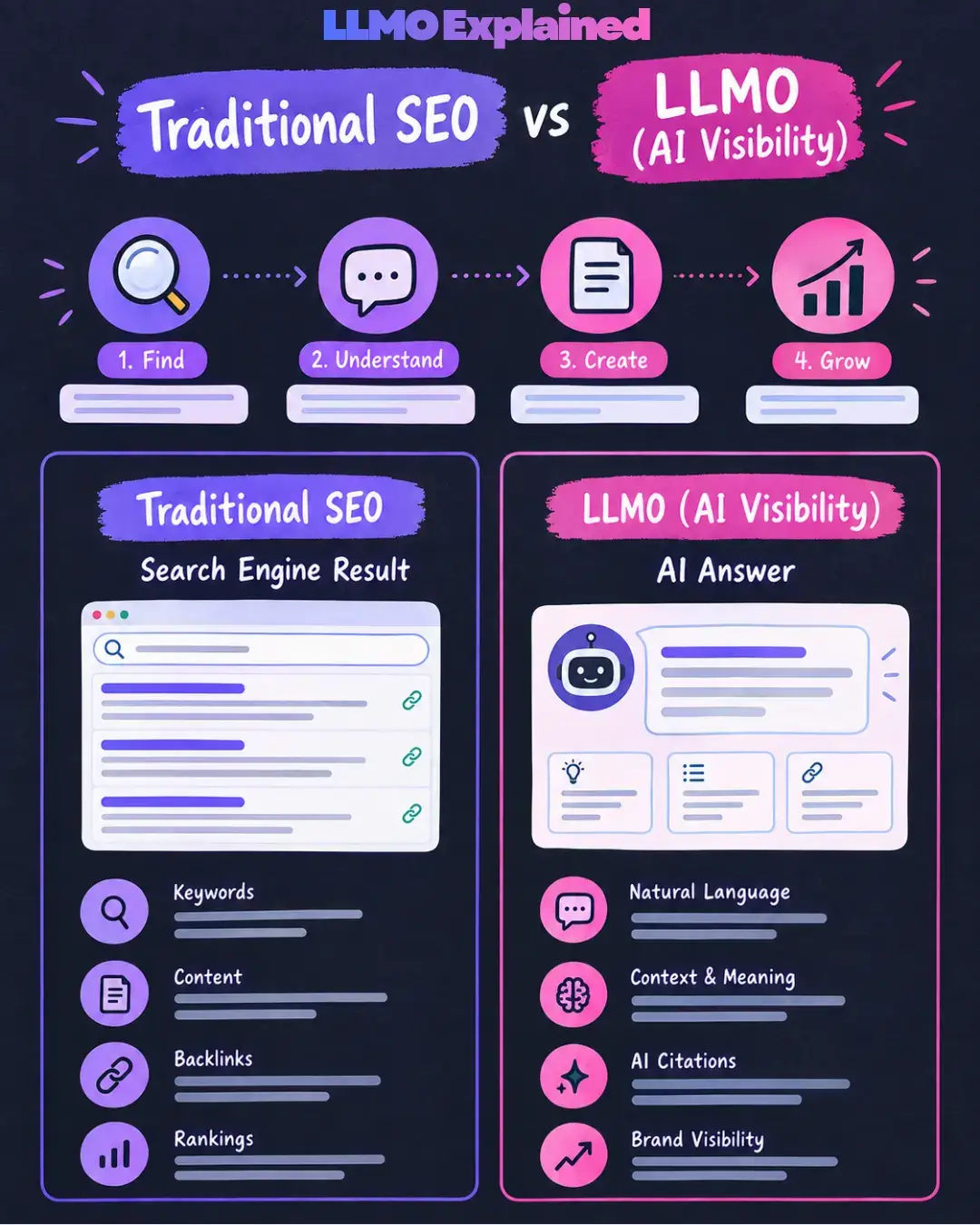
| Traditional SEO | LLMO (AI Visibility) |
|---|---|
| Goal: rank on the results page | Goal: get quoted inside the AI's answer |
| Success measured by clicks and rankings | Success measured by citations and brand mentions, even with zero clicks |
| Keyword density and backlink count carry heavy weight | Clarity, direct answers, and corroboration across sources carry more weight |
| Long, keyword-rich intros are common | The answer needs to appear in the first few sentences |
| One well-optimized page can rank on its own | Topical depth across a cluster of pages builds the trust a model needs |
Why This Shift Matters for Every Business, Not Just Tech Companies
It's tempting to think this is a problem for SaaS companies and tech bloggers. It isn't. Local service providers, e-commerce stores, consultants, agencies, and content publishers are all affected the moment their potential customers start asking an AI assistant instead of typing into a search bar.
Think about how people search now. Instead of "best project management software," someone might ask an AI, "What's the best project management tool for a 10-person marketing team on a budget?" That's a conversational, specific, intent-rich question — and the AI model has to synthesize an answer from whatever sources it deems reliable enough to draw from.
If your content answers that exact kind of question clearly, and your brand has visible authority around the topic, you have a real shot at being cited. If your content is vague, promotional, or buried under fluff before it gets to the point, the model will likely skip it in favor of a source that respects the reader's time.
The businesses that adapt early aren't just protecting their traffic. They're positioning themselves as the default recommendation inside a tool millions of people now consult before they consult a search engine.
How AI Models Decide What to Trust
Language models don't "read" the internet the way a human does, and they don't rank pages the way Google's classic algorithm does either. When an AI assistant answers a question using live or indexed web content, it's generally looking for a few things:
Clarity of the answer itself. Models favor content that states a direct answer early, in plain language, rather than making the reader (or the AI) dig through paragraphs of preamble to find it.
Structural signals. Headings, bullet points, tables, and well-organized sections make it easier for a model to extract a clean, quotable chunk of information. Walls of unbroken text are harder to parse and easier to skip.
Demonstrated expertise. This overlaps with Google's long-standing E-E-A-T framework — Experience, Expertise, Authoritativeness, Trustworthiness. Author bios, credentials, original data, case studies, and a track record of accurate content all feed into whether a model treats a source as reliable.
Consistency across the web. If your brand, your claims, and your data show up consistently across multiple credible sources — your own site, guest posts on authority domains, directories, social profiles — that consistency acts as a trust signal. A single isolated claim on one obscure page carries far less weight than the same claim corroborated elsewhere. This is exactly where a strategy like guest posting on relevant, credible sites pays off for AI visibility, not just backlinks.
Freshness and accuracy. Outdated statistics or stale advice get deprioritized, especially in fast-moving topics like AI, marketing, or technology, where last year's best practice can be actively wrong today.
None of this is mysterious once you see it laid out. It's essentially asking: would a genuinely knowledgeable person trust this source enough to repeat what it says? If the honest answer is no, an AI model will reach the same conclusion.
Practical Ways to Optimize for AI Visibility
1. Answer the question in the first two or three sentences
Every page, blog post, or product description should assume the reader — human or AI — wants the core answer immediately. Save the nuance, examples, and elaboration for after you've delivered the point. This single habit does more for AI visibility than almost anything else on this list.
2. Structure content the way a model wants to extract it
Use descriptive H2 and H3 headings that mirror how someone might phrase a question. Break down comparisons into tables. Use numbered steps for processes. This isn't just good UX — it makes your content easy to lift cleanly into a generated answer. For a deeper walkthrough of this kind of structuring, see our On-Page SEO Playbook for 2026.
3. Build topical depth, not just isolated pages
A single great article rarely earns lasting trust. A cluster of interlinked pages that thoroughly cover a topic — the fundamentals, the edge cases, the comparisons, the mistakes to avoid — signals genuine expertise. Models are more likely to trust and cite a source that clearly knows the subject in depth rather than one post that happens to rank.
4. Add real data, examples, and original insight
Generic advice that repeats what's already on the top ten search results adds nothing new for a model to reference. Original statistics, case studies, screenshots, or a genuinely different point of view give AI systems (and human readers) a reason to pull from your content specifically instead of a dozen interchangeable competitors.
5. Keep your structured data and metadata clean
Schema markup, accurate meta descriptions, and properly labeled headings help both traditional crawlers and AI retrieval systems understand what a page is actually about. This is one of the more technical parts of LLMO, but it's also one of the most overlooked — a page can have excellent content and still get misread simply because the underlying markup is messy or missing.
💡 Behind the Scenes
I built an AI Content Creator tool directly into FeshToolz using the Gemini API, mainly to see firsthand how these models actually process and rank written input. Testing it made one thing obvious: models reward content that states its point plainly over content that circles around it. If you want to see how a live AI-writing tool structures output, you can try the AI Content Creator yourself.
6. Earn mentions on other credible sites
This is where guest posting, digital PR, and link building intersect directly with LLMO. AI models weigh corroboration heavily. A claim, a statistic, or a brand mention that appears on multiple reputable, relevant websites is far more likely to be treated as trustworthy than something that only exists on your own domain. Getting featured on established, topically relevant sites isn't just a backlink play anymore — it's a credibility play that directly feeds AI visibility. If you want a practical, step-by-step approach to this, check out How to Use AI for Guest Post Outreach.
7. Keep content current
Set a habit of revisiting older posts, especially ones covering tools, statistics, or fast-changing practices, and updating them rather than letting them go stale. A model comparing a 2023 statistic against a 2026 one will favor the source with current information, all else being equal.
8. Write for a specific reader, not a search engine
Ironically, the content that performs best for AI retrieval is usually content that was written to genuinely help a specific person solve a specific problem — not content stuffed with keywords aimed at an algorithm. Models are trained to recognize genuinely useful, well-reasoned writing versus content that exists purely to rank. Write the article you'd actually want to read if you were the one asking the question.
An Insight From Running a Guest Posting Business
Working on the vendor and placement side of guest posting day to day gives you a different view of this than reading about it in theory. The sites that consistently get picked up and referenced — by search engines and increasingly by AI tools — are rarely the ones chasing the highest domain authority number. They're the ones with a clear, narrow topical focus and consistent publishing on that topic over time. A site that publishes broadly across ten unrelated niches struggles to build the kind of topical authority that makes a model treat it as a go-to source, no matter how many backlinks it has.
💡 Real Example, Not Theory
I saw this principle play out directly with a YouTube channel I managed: it grew from 750 to 1.6k subscribers in just 60 days — with only 5 new videos uploaded in that window. The growth came from consistent SEO on a narrow topic, not upload volume. The same logic applies to written content that AI models decide whether to trust: depth and focus outperform sheer output every time.

This is also why agencies and SaaS companies running guest posting at scale need to be deliberate about where placements go, not just how many they get. In my own placement network, the difference between a site that gets cited and one that gets ignored usually comes down to whether it's indexed in Google News and holds real domain authority (DA 80+ range), versus a site with numbers that look fine on paper but no actual topical trust behind them. For teams that need this managed end-to-end without building an in-house process, I run a white-label guest posting service for SaaS and agencies, built around exactly this kind of topically relevant, credibility-first placement — the same signal AI models are now weighing when they decide what to cite.
Common Mistakes Businesses Make With LLMO
Treating it as a replacement for SEO. LLMO doesn't work in a vacuum. Technical SEO, site speed, mobile usability, and indexability still matter enormously — a page that isn't properly crawled or indexed can't be retrieved by an AI system in the first place. Our practical guide to on-page SEO in 2026 covers these fundamentals in more detail.
Chasing keywords instead of intent. Traditional keyword stuffing does nothing for AI visibility and can actively hurt readability, which hurts your chances of being cited.
Publishing thin, generic content. If ten other sites already say the same thing in the same way, there's no reason for a model to choose yours. Depth and originality aren't optional anymore — they're the differentiator.
Ignoring off-site credibility. Many businesses pour all their effort into their own website and neglect the external mentions, guest posts, and citations that build the kind of cross-web trust AI models are specifically looking for.
Setting it and forgetting it. AI models retrain and re-crawl. Content that was optimized a year ago and never revisited quietly loses ground to competitors who keep updating.
A Quick Self-Audit: Is Your Content AI-Ready?
Before investing heavily in new content, it's worth auditing what you already have. Pull up your five highest-traffic pages and ask honestly:
- Does the page answer its core question within the first 100 words, or does it bury the point under an introduction?
- Are there clear, descriptive headings a model could use to locate the relevant section quickly?
- Is there anything on the page — a statistic, an example, a perspective — that isn't already sitting on ten competitor pages?
- Would a stranger reading only this page trust the person or brand behind it, based on what's visible?
- Is the information still accurate today, or does it reference tools, prices, or practices that have since changed?
Most sites fail at least two or three of these checks without realizing it, simply because the content was written for a pre-AI internet where getting a click was the only goal. Fixing existing pages is often faster and more impactful than producing new ones, because you're improving something that already has some authority instead of starting from zero.
Frequently Asked Questions
Is LLMO going to replace SEO?
No. LLMO depends on solid SEO fundamentals — indexability, site structure, page speed, and relevance — to even give a model the chance to find and read your content. Think of LLMO as an additional layer built on top of SEO, not a separate discipline competing with it.
Can small businesses realistically compete with large brands for AI citations?
Yes, and often more easily than they can compete for a top Google ranking. AI models are less swayed by domain size and raw backlink volume than classic search rankings historically were, and more focused on whether a specific page directly and clearly answers the exact question being asked. A small, sharply written page can outperform a bloated enterprise article that buries its answer.
Do I need to abandon keyword research?
No. Keyword research still tells you what people are actually searching for and how they phrase it. The difference is that the content built around those keywords now needs to prioritize direct, genuinely useful answers over repetition and density.
How long does it take to see results from LLMO efforts?
It varies by how often the model or search engine re-crawls and re-evaluates your content, but most businesses treat it the same way they treat SEO: a compounding effort measured in months, not days. Early wins often come from fixing existing high-traffic pages rather than waiting on brand-new content to gain traction.
Where This Is Heading
AI-generated answers aren't a passing trend — they're becoming a primary interface for how people find information, compare options, and make decisions. Search engines themselves are leaning further into AI summaries every quarter, which means the overlap between "ranking well" and "being cited by AI" is only going to grow tighter.
The businesses that treat this shift seriously now — by building genuinely authoritative, well-structured, well-corroborated content — are the ones that will still be visible three years from now, whether someone finds them through a traditional search result or through an AI assistant's answer. The ones that ignore it risk becoming invisible in exactly the channel their future customers are increasingly relying on.
LLMO isn't a trick or a shortcut. It's what SEO looks like once you accept that the reader on the other end might not be a person scrolling a results page — it might be a model deciding, in a fraction of a second, whether your content is worth trusting enough to repeat.
If you want help building content and a link profile that's structured for both traditional SEO and AI visibility, I offer guest posting, SEO, LLMO, and content services through Fesh Digital Hub. Reach out or email me at feshdigitalhub@gmail.com. If you write about SEO, AI, or digital marketing yourself, you can also contribute a guest post on FeshToolz.